tomorrowread
Toronto airport arrest ends seven-month manhunt in Indian woman’s murder case
World·Short term·▲ +2%

Canadian prosecutors will move the case forward quickly after the Toronto airport arrest, and the next public focus will be on how Abdul Ghafoori remained at large for more than seven months.

The arrest closes a major cross-border fugitive case involving an Indian national and could surface new details about how he evaded capture for months.

AI reasoning

The arrest closes a major cross-border fugitive case involving an Indian national and could surface new details about how he evaded capture for months.

Curated summary

Abdul Ghafoori, 32, was arrested at Toronto airport on Friday, August 7, and charged with first-degree murder in the death of 30-year-old Indian national Himanshi Khurana. He had been on the run for more than seven months after Khurana was found dead in a Toronto home in December 2025. Police said the case involved an intimate partner relationship and that multiple agencies helped bring him back.

Supporting evidence

Source news

Toronto airport arrest ends seven-month manhunt in Indian woman’s murder case

Abdul Ghafoori was arrested at Toronto airport and charged with first-degree murder in the death of Himanshi Khurana.

World | The Hindu·6h ago
Read full article at World | The Hindu

Related predictions

Netanyahu rejects Trump’s Gaza peace framework, locking in a familiar deadlock
·World·Short term

The Netanyahu-Trump split over the Gaza Board of Peace plan will remain unresolved in the short term, with Israel continuing to insist on complete Hamas disarmament before any pullout.

The rejection narrows the space for any near-term ceasefire breakthrough and makes the U.S. plan look politically stranded between Israeli security demands and Hamas’s position. It also raises the odds that Gaza diplomacy remains hostage to the same sequencing dispute: disarm first, withdraw later.

View Evidence
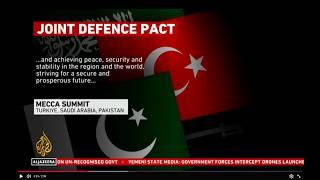
Saudi Arabia, Turkiye and Pakistan formalize a mutual-defense pact
·World·Medium term

The Mecca Joint Deterrence Agreement will draw interest from additional regional governments, but any expansion will depend on whether Saudi Arabia, Turkiye and Pakistan can define consultation and response rules first.

This is one of the most consequential geopolitical developments in the window because it could reshape regional deterrence calculations well beyond the three signatories. The wording is broad enough to invite future expansion, but vague enough to create uncertainty in the meantime.

View Evidence